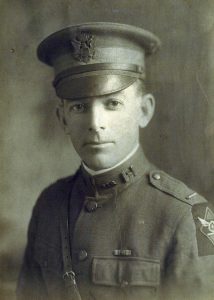
At the turn of the twentieth century my Great Uncle Richard, together with his brother Fred, emigrated to the United States. They ultimately settled in Salt Lake City where they found jobs in the oil industry. When the United States entered World War 1 in April 1917 Fred chose to serve under the star-spangled banner and enlisted in the US Army (pictured below).
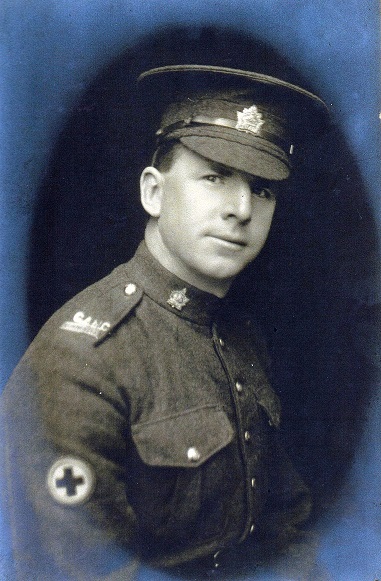
Not so, Richard. His allegiance was to ‘King and Country’. He travelled to Canada where, on 12 September 1917 in Victoria BC, he enlisted to serve in the Canadian Army. Coincidentally, on the same date 40 years later, I was called up to serve ‘Queen and Country’ in the British Army.
Similarities: World War I to Malaya
Apart from the fact that my eponymous great uncle volunteered and I was conscripted, our service records show that we shared a lot in common. We were both five feet seven inches tall on enlistment. We both had a defective left eye. In addition, both of us had scars on our left wrist/hand.
By courtesy of the mighty military machine, we were both treated to free return ocean cruises to our respective war zones. Also, we both forfeited five days’ pay during our service. The elder Richard’s forfeiture was for being ‘absent without leave’ after returning from France (probably to visit family in Nottingham). Mine was for ‘causing a disturbance in the barrack room’ (see my memoir to discover why such an innocuous sounding offence was so costly).
There was one difference in our respective military service in World War I to Malaya. My great uncle at one point rose to the dizzying rank of Acting Lance Corporal. I never progressed beyond acting the fool.
Duration of Service
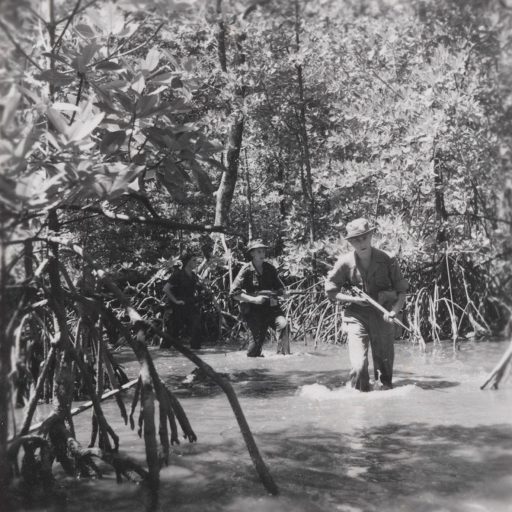
Our respective service in World War I and Malaya lasted 18 months in in the case of my great uncle. Five of these were served in France on active or post-Armistice service. In my case, two years: 15 months of which were spent on active service in Malaya.
Awards
Both my great uncle and I were awarded two medals for our service in World War I and Malaya. However, Richard the elder was awarded both of his, the British War Medal and the Victory Medal (known as ‘the pair’), on his discharge in 1919.
I received one of mine, the General Service Medal (Malaya Clasp), on my discharge in September 1959. However, I had to wait 45 years to receive the second. The Pingat Jasa Malaysia was awarded in 2004 by the King of Malaysia. It was given to all Malaysian and other Commonwealth service personnel who had served in ‘the Emergency’ or ‘Konfrontasi’. Owing to British Medals Policy at the time, I had to wait another seven years for permission to wear it. For why, see ‘Thanks for your service’ – Dec 16, 2025 blog.
Remuneration
The greatest disparity in our respective military service in World War I and Malaya, was that my great uncle enjoyed significantly higher remuneration than I did. He was paid CAD$15 per month throughout his service between 1917 and 1919. Adjusted for inflation between 1917 and 1957, my great uncle’s monthly pay would have almost doubled to nearly CAD$30 when I was called up in 1957. How much when converted to pounds sterling at the prevailing exchange rate at the time? Well, this would have been worth around ten pounds a month. In comparison, I was getting 28 shillings a week, or a little over six pounds a month.
However, the most telling difference was that my great uncle’s World War I medals came with a CAD$280.00 War Service Gratuity. This was worth CAD$560.00, or a little over £200, when I was demobbed in 1959. The only gratuity that came with my GSM was a utilitarian cardboard box in which to keep it.